Co-operation relations between Portugal and Guinea-Bissau
Dados Gerais
 Designação Oficial: República da Guiné-Bissau
Capital: Bissau
Presidente da República: Umaro Sissoco Embaló
Primeiro-Ministro: Nuno Gomes Nabiam
Data da Independência: 10 de setembro de 1974
Regiões: Bafatá, Biombo, Bolama, Cacheu, Gabú, Oio, Quinara, Setor autónomo de Bissau e Tombali.
Línguas: Português (oficial), Crioulo, Balanta, Mandinga, Fula, Manjaco, Papel e Mancanha.
Religião: Animistas (55%), Muçulmanos (40%), Católicos e Outros (5%).
 Informação Geográfica
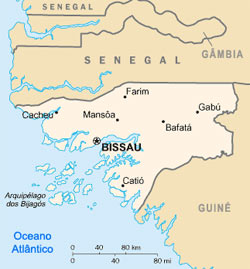
Área: 36 125 Km2
Clima: Tropical Húmido, com 2 Estações: a Seca (novembro a meados de maio) e a das Chuvas (meados de maio a fins de outubro)
Informação Demográfica
População: 2,06 milhões de habitantes (2021-BM)
Taxa de Crescimento Anual da População: 2,2% (2021-BM)
Esperança de Vida: 60 anos (2020-BM)
Taxa de Alfabetização de Adultos (15 anos e mais): 53% (2021-BM)
Índice de Desenvolvimento Humano: 177.ª posição (2021-PNUD)
Informação Económica
Unidade Monetária: Franco CFA (1 EUR = 665,957 CFA, paridade fixa)
PIB Per Capita: 789 USD (2023-AICEP, est.)
Taxa de Inflação: 7,9% (2023-AICEP)
Taxa de Desemprego: 11,5% (2022-AICEP, est.)
Taxa de Crescimento do PIB: 3,2% (2023-AICEP, est.)
Principais Exportações: Produtos Agrícolas (castanha de cajú), Combustíveis Minerais, Veículos e Outro Material de Transporte, Metais Comuns, Máquinas e Aparelhos (2021-AICEP)
Exportações Portugal: 130 milhões de euros (2022-AICEP)
Importações Portugal: 224 mil euros (2022-AICEP)
Investimento Direto Português: 80% empresas, Serviços e Distribuição (2018-AICEP)
Principais Investidores: n.d.
Outros Dados
Embaixada de Portugal em Bissau
Embaixador: José Rui Baptista Borges Velez Caroço
Morada (Embaixada): Avenida Cidade de Lisboa, Apartado 76, 1021 Bissau
Telefone: (+245) 966 990 029
Adido para a Cooperação: António Nunes
E-mail:
Embaixada da República da Guiné-Bissau em Lisboa
Embaixador: Augusto Artur Antônio da Silva
Morada (Embaixada): Rua de Alcolena, n.º 17, 1400-004 Lisboa
Telefone: 213 009 080
Ponto de Situação - Guiné-Bissau
Enquadramento Geral
A estratégia de cooperação entre Portugal e a Guiné-Bissau enquadra-se nos objetivos do Conceito Estratégico da Cooperação Portuguesa 2014-2020 e nas opções definidas pelas autoridades guineenses, consubstanciadas nas orientações e objetivos do Programa Estratégico Operacional “Terra Ranka” 2015-2020.
Portugal tem sido o maior doador bilateral na Guiné-Bissau. No período 2011-2016 a Ajuda Pública ao Desenvolvimento (APD) bilateral Portugal – Guiné-Bissau apresentou os seguintes valores, em euros:
|
2011 |
2012 a) |
2013 a) |
2014 |
2015 |
2016 |
|
9 829 376€ |
7 400 231€ |
6 054 326€ |
8 410 138€ |
12 324 146€ |
11 730 271€ |
a) apoio institucional suspenso na sequência do golpe de estado
Refira-se que o decréscimo da ajuda em 2012 e 2013 deriva do facto de Portugal ter reduzido a intervenção da cooperação devido ao golpe de estado de 12 de abril de 2012 que determinou a suspensão da cooperação institucional. Todavia, Portugal permaneceu no terreno com projetos desenvolvidos por ONGD num apoio direto às populações em setores prioritários como a Educação, a Saúde e o Desenvolvimento Rural.
Programa Estratégico de Cooperação Portugal Guiné-Bissau 2015-2020
A 6 de julho de 2015 foi assinado em Bissau o Programa Estratégico de Cooperação Portugal Guiné-Bissau 2015-2020 que compreende dois eixos de intervenção: Eixo I – Governação, Estado de Direito e Direitos Humanos; Eixo II – Desenvolvimento Humano e Bens Públicos Globais.
Programa Estratégico de Cooperação Portugal – Guiné-Bissau 2021-2025
Programa Estratégico de Cooperação Portugal – Guiné-Bissau 2021-2025 - Ver documento
Plano de Ação novembro 2014 - junho 2015 - Texto em Português
Co-operation in Numbers
Portuguese Official Development Assistance to Guinea-Bissau
The downward trend in aid to Guinea-Bissau until 2013 has been reversed. In 2022, ODA to that country doubled compared to 2011, benefiting from budget support of €5 million and the donation of vaccines as part of the fight against the COVID-19 pandemic. In 2023 and 2024, however, the figures fell. In 2024, Guinea-Bissau was the sixth largest recipient of Portuguese ODA.
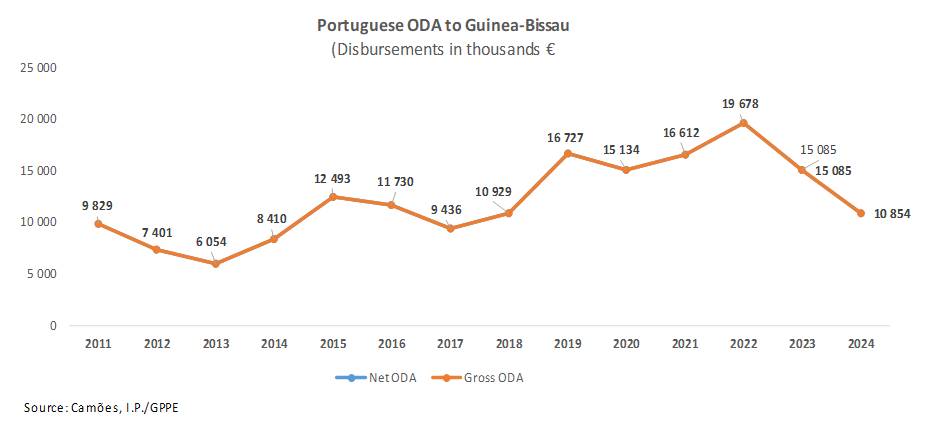
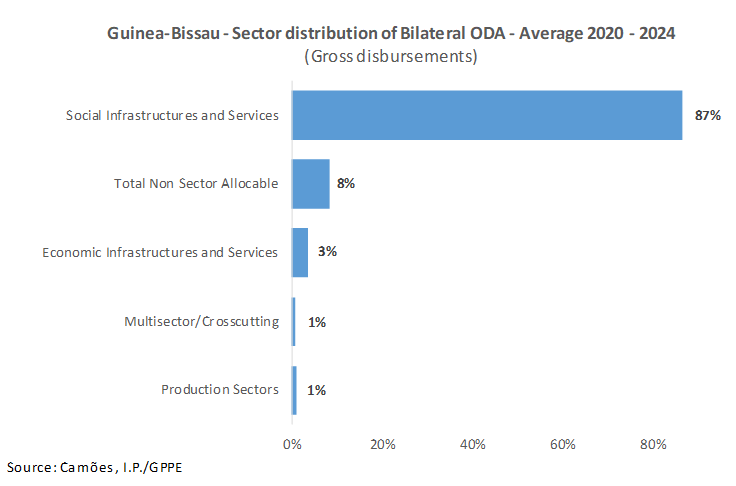
There is an almost total concentration in the “Social Infrastructure and Services” sector grouping (Education, Health, Population and Reproductive Health, Government and Civil Society, Other Social Infrastructure and Services), representing, on average, 87% of total aid.